Projects operating or completed
Attitude (orientation) controledit
Both the Mariner 10 mission, which flew by the planets Mercury and Venus, and the MESSENGER mission to Mercury demonstrated the use of solar pressure as a method of attitude control in order to conserve attitude-control propellant.
Hayabusa also used solar pressure on its solar paddles as a method of attitude control to compensate for broken reaction wheels and chemical thruster.
MTSAT-1R (Multi-Functional Transport Satellite)'s solar sail counteracts the torque produced by sunlight pressure on the solar array. The trim tab on the solar array makes small adjustments to the torque balance.
Ground deployment testsedit
NASA has successfully tested deployment technologies on small scale sails in vacuum chambers.
On February 4, 1993, the Znamya 2, a 20-meter wide aluminized-mylar reflector, was successfully deployed from the Russian Mir space station. Although the deployment succeeded, propulsion was not demonstrated. A second test, Znamya 2.5, failed to deploy properly.
In 1999, a full-scale deployment of a solar sail was tested on the ground at DLR/ESA in Cologne.
Suborbital testsedit
A joint private project between Planetary Society, Cosmos Studios and Russian Academy of Science in 2001 made a suborbital prototype test, which failed because of rocket failure.
A 15-meter-diameter solar sail (SSP, solar sail sub payload, soraseiru sabupeiro-do) was launched together with ASTRO-F on a M-V rocket on February 21, 2006, and made it to orbit. It deployed from the stage, but opened incompletely.
On August 9, 2004, the Japanese ISAS successfully deployed two prototype solar sails from a sounding rocket. A clover-shaped sail was deployed at 122 km altitude and a fan-shaped sail was deployed at 169 km altitude. Both sails used 7.5-micrometer film. The experiment purely tested the deployment mechanisms, not propulsion.
IKAROS 2010edit
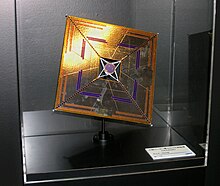
On 21 May 2010, Japan Aerospace Exploration Agency (JAXA) launched the world's first interplanetary solar sail spacecraft "IKAROS" (Interplanetary Kite-craft Accelerated by Radiation Of the Sun) to Venus. Using a new solar-photon propulsion method, it was the first true solar sail spacecraft fully propelled by sunlight, and was the first spacecraft to succeed in solar sail flight.
JAXA successfully tested IKAROS in 2010. The goal was to deploy and control the sail and, for the first time, to determine the minute orbit perturbations caused by light pressure. Orbit determination was done by the nearby AKATSUKI probe from which IKAROS detached after both had been brought into a transfer orbit to Venus. The total effect over the six month flight was 100 m/s.
Until 2010, no solar sails had been successfully used in space as primary propulsion systems. On 21 May 2010, the Japan Aerospace Exploration Agency (JAXA) launched the IKAROS (Interplanetary Kite-craft Accelerated by Radiation Of the Sun) spacecraft, which deployed a 200 m2 polyimide experimental solar sail on June 10. In July, the next phase for the demonstration of acceleration by radiation began. On 9 July 2010, it was verified that IKAROS collected radiation from the Sun and began photon acceleration by the orbit determination of IKAROS by range-and-range-rate (RARR) that is newly calculated in addition to the data of the relativization accelerating speed of IKAROS between IKAROS and the Earth that has been taken since before the Doppler effect was utilized. The data showed that IKAROS appears to have been solar-sailing since 3 June when it deployed the sail.
IKAROS has a diagonal spinning square sail 14×14 m (196 m2) made of a 7.5-micrometre (0.0075 mm) thick sheet of polyimide. The polyimide sheet had a mass of about 10 grams per square metre. A thin-film solar array is embedded in the sail. Eight LCD panels are embedded in the sail, whose reflectance can be adjusted for attitude control. IKAROS spent six months traveling to Venus, and then began a three-year journey to the far side of the Sun.
NanoSail-D 2010edit
A team from the NASA Marshall Space Flight Center (Marshall), along with a team from the NASA Ames Research Center, developed a solar sail mission called NanoSail-D, which was lost in a launch failure aboard a Falcon 1 rocket on 3 August 2008. The second backup version, NanoSail-D2, also sometimes called simply NanoSail-D, was launched with FASTSAT on a Minotaur IV on November 19, 2010, becoming NASA's first solar sail deployed in low earth orbit. The objectives of the mission were to test sail deployment technologies, and to gather data about the use of solar sails as a simple, "passive" means of de-orbiting dead satellites and space debris. The NanoSail-D structure was made of aluminium and plastic, with the spacecraft massing less than 10 pounds (4.5 kg). The sail has about 100 square feet (9.3 m2) of light-catching surface. After some initial problems with deployment, the solar sail was deployed and over the course of its 240-day mission reportedly produced a "wealth of data" concerning the use of solar sails as passive deorbit devices.
NASA launched the second NanoSail-D unit stowed inside the FASTSAT satellite on the Minotaur IV on November 19, 2010. The ejection date from the FASTSAT microsatellite was planned for December 6, 2010, but deployment only occurred on January 20, 2011.
Planetary Society LightSail Projectsedit
On June 21, 2005, a joint private project between Planetary Society, Cosmos Studios and Russian Academy of Science launched a prototype sail Cosmos 1 from a submarine in the Barents Sea, but the Volna rocket failed, and the spacecraft failed to reach orbit. They intended to use the sail to gradually raise the spacecraft to a higher Earth orbit over a mission duration of one month. The launch attempt sparked public interest according to Louis Friedman. Despite the failed launch attempt of Cosmos 1, The Planetary Society received applause for their efforts from the space community and sparked a rekindled interest in solar sail technology.
On Carl Sagan's 75th birthday (November 9, 2009) the Planetary Society announced plans to make three further attempts, dubbed LightSail-1, -2, and -3. The new design will use a 32 m2 Mylar sail, deployed in four triangular segments like NanoSail-D. The launch configuration is a 3U CubeSat format, and as of 2015, it was scheduled as a secondary payload for a 2016 launch on the first SpaceX Falcon Heavy launch.
"LightSail-1" was launched on 20 May 2015. The purpose of the test was to allow a full checkout of the satellite's systems in advance of LightSail-2. Its deployment orbit was not high enough to escape Earth's atmospheric drag and demonstrate true solar sailing.
"LightSail-2" was launched on 25 June 2019, and deployed into a much higher low Earth orbit. Its solar sails were deployed on 23 July 2019.

Comments
Post a Comment