Projects in development or proposed
Despite the losses of Cosmos 1 and NanoSail-D (which were due to failure of their launchers), scientists and engineers around the world remain encouraged and continue to work on solar sails. While most direct applications created so far intend to use the sails as inexpensive modes of cargo transport, some scientists are investigating the possibility of using solar sails as a means of transporting humans. This goal is strongly related to the management of very large (i.e. well above 1 km2) surfaces in space and the sail making advancements. Development of solar sails for manned space flight is still in its infancy.
Sunjammer 2015edit
A technology demonstration sail craft, dubbed Sunjammer, was in development with the intent to prove the viability and value of sailing technology. Sunjammer had a square sail, 124 feet (38 meters) wide on each side (total area 13,000 sq ft or 1,208 sq m). It would have traveled from the Sun-Earth L1 Lagrangian point 900,000 miles from Earth (1.5 million km) to a distance of 1,864,114 miles (3 million kilometers). The demonstration was expected to launch on a Falcon 9 in January 2015. It would have been a secondary payload, released after the placement of the DSCOVR climate satellite at the L1 point. Citing a lack of confidence in the ability of its contractor L'Garde to deliver, the mission was cancelled in October 2014.
Gossamer deorbit sailedit
As of December 2013update, the European Space Agency (ESA) has a proposed deorbit sail, named "Gossamer", that would be intended to be used to accelerate the deorbiting of small (less than 700 kilograms (1,500 lb)) artificial satellites from low Earth orbits. The launch mass is 2 kilograms (4.4 lb) with a launch volume of only 15×15×25 centimetres (0.49×0.49×0.82 ft). Once deployed, the sail would expand to 5 by 5 metres (16 ft × 16 ft) and would use a combination of solar pressure on the sail and increased atmospheric drag to accelerate satellite reentry.
NEA Scoutedit
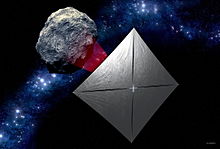
The Near-Earth Asteroid Scout (NEA Scout) is a mission being jointly developed by NASA's Marshall Space Flight Center (MSFC) and the Jet Propulsion Laboratory (JPL), consisting of a controllable low-cost CubeSat solar sail spacecraft capable of encountering near-Earth asteroids (NEA). Four 7 m (23 ft) booms would deploy, unfurling the 83 m2 (890 sq ft) aluminized polyimide solar sail. In 2015, NASA announced it had selected NEA Scout to launch as one of several secondary payloads aboard Artemis 1, the first flight of the agency's heavy-lift SLS launch vehicle.
OKEANOSedit
OKEANOS (Outsized Kite-craft for Exploration and Astronautics in the Outer Solar System) was a proposed mission concept by Japan's JAXA to Jupiter's Trojan asteroids using a hybrid solar sail for propulsion; the sail would have been covered with thin solar panels to power an ion engine. In-situ analysis of the collected samples would have been performed by either direct contact or using a lander carrying a high-resolution mass spectrometer. A lander and a sample-return to Earth were options under study. The OKEANOS Jupiter Trojan Asteroid Explorer was a finalist for Japan's ISAS' 2nd Large-class mission to be launched in the late 2020s. However, it was not selected.
Breakthrough Starshotedit
The well-funded Breakthrough Starshot project announced on April 12, 2016, aims to develop a fleet of 1000 light sail nanocraft carrying miniature cameras, propelled by ground-based lasers and send them to Alpha Centauri at 20% the speed of light. The trip would take 20 years.
Solar Cruiseredit
In August 2019, NASA awarded the Solar Cruiser team $400,000 for nine-month mission concept studies. The spacecraft would have a 1,672 m2 (18,000 sq ft) solar sail and would orbit the Sun in a polar orbit, while the coronagraph instrument would enable simultaneous measurements of the Sun's magnetic field structure and velocity of coronal mass ejections. If selected for development, it would launch in 2024.


Comments
Post a Comment