Operations
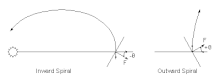
Changing orbitsedit
Sailing operations are simplest in interplanetary orbits, where altitude changes are done at low rates. For outward bound trajectories, the sail force vector is oriented forward of the Sun line, which increases orbital energy and angular momentum, resulting in the craft moving farther from the Sun. For inward trajectories, the sail force vector is oriented behind the Sun line, which decreases orbital energy and angular momentum, resulting in the craft moving in toward the Sun. It is worth noting that only the Sun's gravity pulls the craft toward the Sun—there is no analog to a sailboat's tacking to windward. To change orbital inclination, the force vector is turned out of the plane of the velocity vector.
In orbits around planets or other bodies, the sail is oriented so that its force vector has a component along the velocity vector, either in the direction of motion for an outward spiral, or against the direction of motion for an inward spiral.
Trajectory optimizations can often require intervals of reduced or zero thrust. This can be achieved by rolling the craft around the Sun line with the sail set at an appropriate angle to reduce or remove the thrust.
Swing-by maneuversedit
A close solar passage can be used to increase a craft's energy. The increased radiation pressure combines with the efficacy of being deep in the Sun's gravity well to substantially increase the energy for runs to the outer Solar System. The optimal approach to the Sun is done by increasing the orbital eccentricity while keeping the energy level as high as practical. The minimum approach distance is a function of sail angle, thermal properties of the sail and other structure, load effects on structure, and sail optical characteristics (reflectivity and emissivity). A close passage can result in substantial optical degradation. Required turn rates can increase substantially for a close passage. A sail craft arriving at a star can use a close passage to reduce energy, which also applies to a sail craft on a return trip from the outer Solar System.
A lunar swing-by can have important benefits for trajectories leaving from or arriving at Earth. This can reduce trip times, especially in cases where the sail is heavily loaded. A swing-by can also be used to obtain favorable departure or arrival directions relative to Earth.
A planetary swing-by could also be employed similar to what is done with coasting spacecraft, but good alignments might not exist due to the requirements for overall optimization of the trajectory.
The following table lists some example concepts using beamed laser propulsion as proposed by the physicist Robert L. Forward:
| Mission | Laser Power | Vehicle Mass | Acceleration | Sail Diameter | Maximum Velocity (% of the speed of light) |
|---|---|---|---|---|---|
| 1. Flyby – Alpha Centauri, 40 years | |||||
| outbound stage | 65 GW | 1 t | 0.036 g | 3.6 km | 11% @ 0.17 ly |
| 2. Rendezvous – Alpha Centauri, 41 years | |||||
| outbound stage | 7,200 GW | 785 t | 0.005 g | 100 km | 21% @ 4.29 ly |
| deceleration stage | 26,000 GW | 71 t | 0.2 g | 30 km | 21% @ 4.29 ly |
| 3. Manned – Epsilon Eridani, 51 years (including 5 years exploring star system) | |||||
| outbound stage | 75,000,000 GW | 78,500 t | 0.3 g | 1000 km | 50% @ 0.4 ly |
| deceleration stage | 21,500,000 GW | 7,850 t | 0.3 g | 320 km | 50% @ 10.4 ly |
| return stage | 710,000 GW | 785 t | 0.3 g | 100 km | 50% @ 10.4 ly |
| deceleration stage | 60,000 GW | 785 t | 0.3 g | 100 km | 50% @ 0.4 ly |
Interstellar travel catalog to use photogravitational assists for a full stop.edit
| Name | Travel time (yr) |
Distance (ly) |
Luminosity (L☉) |
|---|---|---|---|
| Sirius A | 68.90 | 8.58 | 24.20 |
| α Centauri A | 101.25 | 4.36 | 1.52 |
| α Centauri B | 147.58 | 4.36 | 0.50 |
| Procyon A | 154.06 | 11.44 | 6.94 |
| Vega | 167.39 | 25.02 | 50.05 |
| Altair | 176.67 | 16.69 | 10.70 |
| Fomalhaut A | 221.33 | 25.13 | 16.67 |
| Denebola | 325.56 | 35.78 | 14.66 |
| Castor A | 341.35 | 50.98 | 49.85 |
| Epsilon Eridiani | 363.35 | 10.50 | 0.50 |
- Successive assists at α Cen A and B could allow travel times to 75 yr to both stars.
- Lightsail has a nominal mass-to-surface ratio (σnom) of 8.6×10⁻⁴ gram m−2 for a nominal graphene-class sail.
- Area of the Lightsail, about 105 m2 = (316 m)2
- Velocity up to 37,300 km s−1 (12.5% c)
. Ref:


Comments
Post a Comment